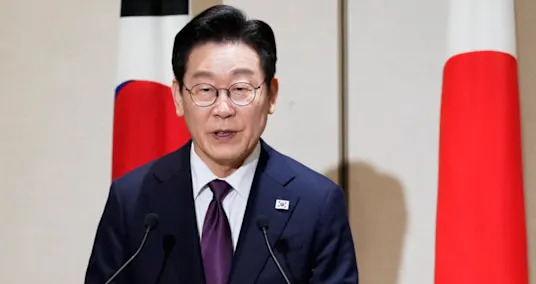
South Korean president Lee Jae Myung said the global energy crisis caused by the US-Israeli war on Iran was keeping him up at night as he called for a rapid transition to renewable energy.
The situation was “worse than you think” and could deteriorate further, he said and urged his nation to move “quickly” away from fossil fuels.
“The whole world is in chaos because of the energy issue and it’s so serious I can't fall asleep either,” Mr Lee said during a town hall meeting on the southern island of Jeju on Monday, Yonhap reported.
"We do not even produce fossil fuels ourselves and now even importing them is becoming like this.”
The oil crisis has hit Asia harder than anywhere else. Japan, South Korea and India – among the world's largest economies – are all heavily reliant on Middle Eastern energy and have been left scrambling to cover shortfalls by the closure of the Strait of Hormuz.

South Korea imports about 55 per cent of its energy, worth $144 billion in 2024, from the Middle East. Japan relies on the region for roughly 90 per cent of its oil. India, the world's third largest oil importer, sources the bulk of its crude from the Gulf.
The disruption stems from Iran’s closure of the Strait of Hormuz, through which a quarter of the world’s oil and a fifth of its LNG shipments transit daily. Strikes on Qatar's Ras Laffan facility, the world's largest LNG export hub, have compounded the shortage.
Nearly 30 billion cubic metres of LNG have been removed from the global supply chain since the conflict began, more than 80 per cent of it from the Indo-Pacific region. The last few cargoes that passed through the strait before the war escalated were expected to arrive in the coming days, with experts warning the damage to supply infrastructure could take years to repair.
As oil and gas supplies dwindle, Asian nations are falling back on coal. South Korea has delayed the shutdown of its coal-fired power plants and lifted caps on electricity from coal. Japan has made the same reversal, allowing less-efficient coal plants back into its power market from April, according to documents from the trade ministry, a move expected to offset about 500,000 metric tonnes of LNG use.

India, which already relies on coal for nearly 75 per cent of its power generation, has asked its plants to run at maximum capacity and avoid planned outages.
Bangladesh has increased both coal-fired power generation and coal imports.
This marks a significant reversal for countries that had been cutting their dependence on coal. Japan was one of only five major polluting nations to cut total greenhouse gas emissions in 2024, achieving a 2.8 per cent reduction, according to European Commission data. Its target to cut emissions by 60 per cent by 2035 from 2013 levels was already deemed insufficient to reach net zero by 2050. The trade ministry described the coal expansion as temporary.
In spite of the coal reversal, major Asian economies are accelerating their clean energy production.
Korean newspaper Dong-A Ilbo reported that when Mr Lee's energy minister announced a plan to require all new cars in Jeju to be electric by 2035, he pushed back.
"What do you mean 10 years from now? That's too slow," the president said. "This is an emergency situation."
India and Japan are also accelerating clean energy build-up. Delhi has sped up clearances for wind power plants and battery energy storage systems.
Japan is accelerating a longer-term shift towards nuclear power generation, seeking energy sources that bypass the Strait of Hormuz entirely and reduce its dependence on supply from the Middle East.
LATEST POSTS
- 1
 How to watch 'A Charlie Brown Christmas' for free this weekend
 - 2'Outrageous and illegal' : UNRWA slams Israel for cutting off its water, comms and electric in Gaza
- 3Courageous Climbing: Trails and Stuff for Outside Lovers
- 4Spots To Go Birdwatching All over the Planet
- 5Investigating the Medical advantages of Aloe Vera


- Texas cities have some of the highest preterm birth rates in the US, highlighting maternal health crisis nationwide
- The 2026 'Super Bowl of Astronomy' starts today — here's what's happening
- This Miraculous, Cliff-Perched Town In The South Of France Is A Sacred European Gem
- ONE returns to Red Sea with new service
- VPN Administrations for Online Protection
- Vote In favor of Your Favored Language Interpretation Administration
- Ukraine confirms defence and energy ministers at second attempt
- From Dread to Certainty: Individual Accounts of Strengthening
- I went to Japan during peak cherry blossom season and found an easy way to escape the crowds at popular tourist attractions